

CBR INTELLIGENCE NOTE
CARICOM at a Threshold
Authority, Process and Institutional Viability.
CBR Intelligence Note | Vol. 1, No. 8
Joseph Cox
Managing Partner, Joseph Cox & Associates Limited
Publisher, Caribbean Business Review
April 15, 2026
Classification: Public
Suggested Citation:
Cox, J. (2026). CARICOM at a Threshold: Authority, Process and Institutional Viability. CBR Intelligence Note, Vol. 1, No. 8. Caribbean Business Review.
Disclaimer
This document reflects the independent analysis and professional opinions of the Caribbean Business Review and Caribbean Financial Dispatch units of Joseph Cox & Associates Limited.
The views expressed herein are those of the author and do not constitute legal, financial, investment, or policy advice. While reasonable care has been taken to ensure analytical integrity, no representation or warranty is made as to completeness or accuracy. Readers are encouraged to exercise independent judgment and undertake appropriate due diligence.
This material is provided strictly for informational and discussion purposes.
© 2026 Caribbean Business Review. All rights reserved.
Key Judgement
CARICOM is approaching a threshold at which contested authority—arising from questions surrounding participation, representation, and process under Articles 28 and 11(2) of the Revised Treaty of Chaguaramas—may impair institutional function and constrain the Community’s capacity for coordinated decision-making.
Abstract
This note examines the reappointment of the CARICOM Secretary-General through the lens of Article 28 and Article 11(2) of the Revised Treaty of Chaguaramas. It assesses participation, representation, and process design, and identifies emerging risks to institutional coherence. The analysis concludes that contested authority now presents a constraint on CARICOM’s functional capacity.
Key Takeaways
Threshold Risk: Participation levels raise questions as to whether Article 28 requirements were satisfied in substance.
Representation Constraint: Article 11(2) rights may not have been meaningfully exercisable under a “Heads only” structure.
Process Integrity: Decision-making appears to have occurred within a segmented framework that limited participation.
System Constraint: Contested authority is now affecting institutional coherence, not just perception.
Executive Signal
CARICOM is no longer managing a procedural disagreement—it is confronting a test of institutional legitimacy. The issue is not whether a decision was made, but whether that decision can function under open contestation.
The reappointment of Secretary-General Dr. Carla Barnett was, on its face, a continuity decision. But the process surrounding that decision has now moved beyond administrative routine into a contested institutional episode with implications for governance, financing, and regional cohesion.
At the core of the dispute is not simply whether the decision was taken—but whether it satisfies the requirements of collective decision-making under the Revised Treaty of Chaguaramas.
Participation, Threshold and Article 28
Available information indicates that only 10 of 15 Heads of Government were represented at the Retreat where the matter was considered. Article 28 provides that decisions of the Conference require the affirmative vote of all members or, where abstentions occur, the support of three-quarters of the membership.
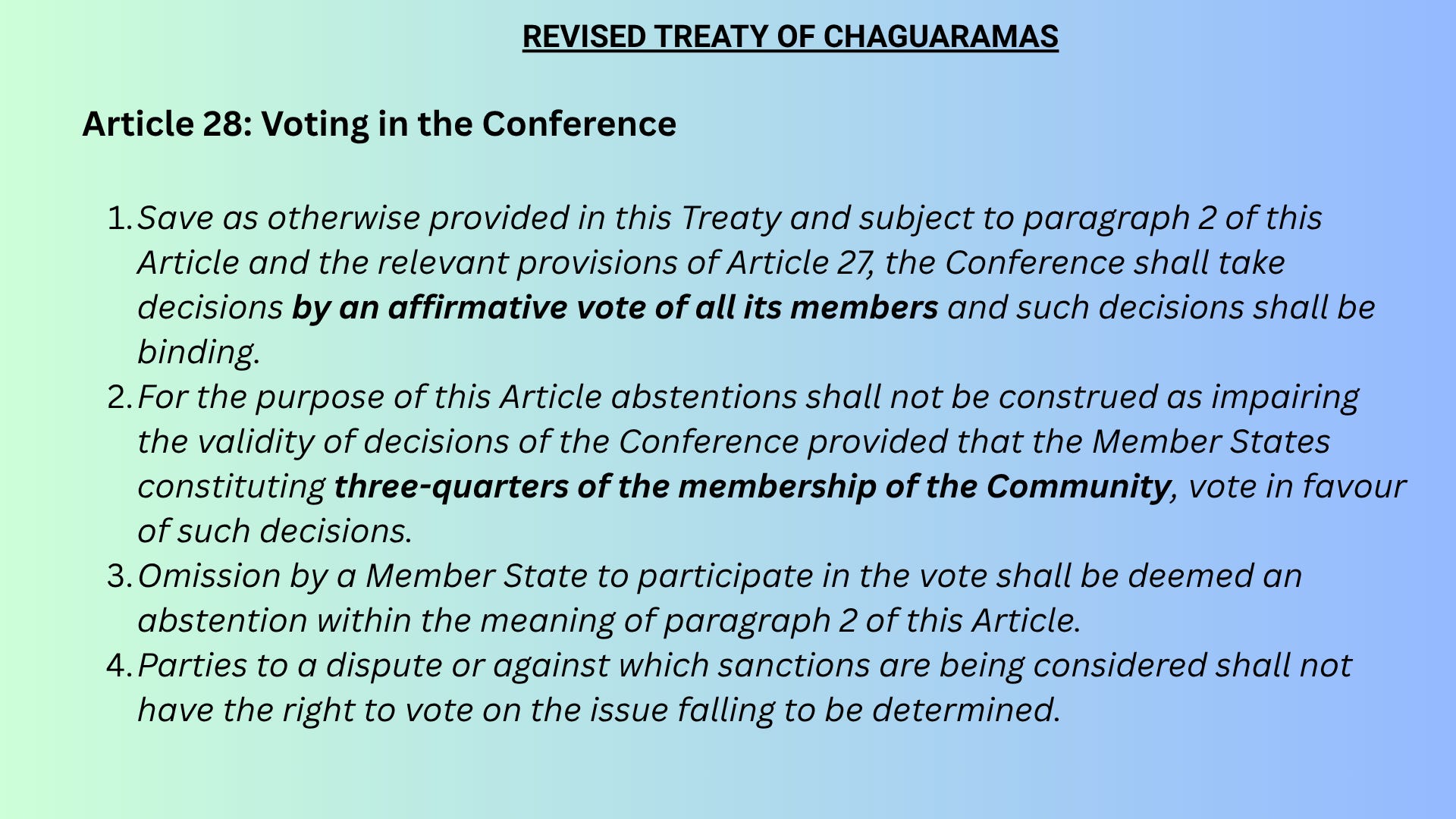
Three-quarters of 15 implies a threshold of 12.
Even if all represented Heads supported the decision, participation at that level raises a fundamental question: can absent members be treated as abstaining where the item was not formally placed on the agenda and therefore not reasonably anticipated as a decision point?
In a consensus-based system, abstention is not passive—it is informed. Where awareness is uncertain, the presumption of abstention becomes materially weak. A quorum of presence is not equivalent to a threshold of decision.
This does not establish illegality. It does, however, raise a material question as to whether the Article 28 requirement was satisfied in substance, even if asserted in form.
Process Segmentation and Managed Participation
Further complexity arises from the structure of the Retreat itself. Available communications indicate that the Secretariat, on behalf of the Chair, designated the session as “Heads only” while simultaneously assigning tasks to the Community Council—comprising Ministers of Foreign Affairs—to be completed during the same period.
This is analytically significant. It suggests that Ministers were not merely absent from the deliberations—they were actively engaged elsewhere by design. Non-participation in this context cannot be interpreted as passive absence or abstention. It reflects a structured separation of roles at the point of decision-making.
Where participation is administratively redirected rather than simply unavailable, the presumption of informed abstention becomes untenable, raising further questions as to whether the conditions for collective decision-making under Article 28 were satisfied in substance.
Representation, Article 11(2) and the Limits of Participation
A further layer of complexity arises when considered against Article 11(2) of the Revised Treaty of Chaguaramas, which provides that a Head of Government may designate a Minister or other person to represent them at any Meeting of the Conference.
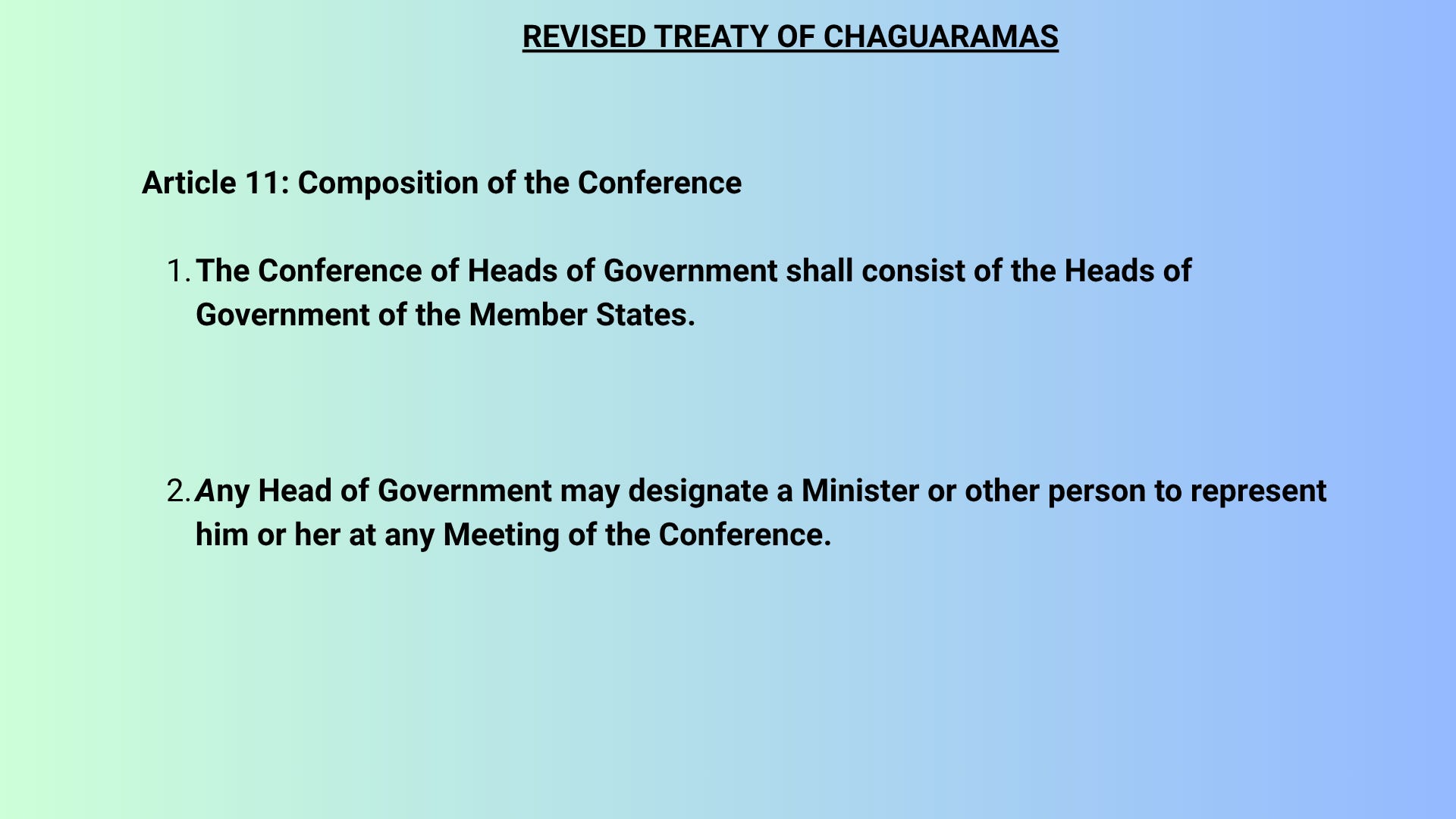
This provision is designed to ensure continuity of participation and preserve the principle of collective decision-making, even where a Head is unable to attend.
However, the designation of the session as “Heads only”, combined with the concurrent engagement of Ministers in Community Council business, suggests that designated representatives were not merely absent—they were precluded from participation by design.
In such circumstances, the right of representation provided under Article 11(2) exists in form but raises questions as to whether it was meaningfully exercisable in practice.
Where representatives are excluded from the deliberative forum and structurally redirected to parallel functions, the distinction between formal entitlement and effective participation becomes material. This, in turn, reinforces the difficulty of treating absence as informed abstention under Article 28.
A right of representation that cannot be exercised at the point of decision raises fundamental questions about the integrity of the process itself.
Decision Versus Communication
The Chairman’s statement indicates that the formal announcement of the decision was delayed in order to inform absent Heads. That sequence—decision first, notification later—introduces a second layer of concern.
A process that concludes with notification rather than participation raises questions about whether collective decision-making was achieved—or presumed.
This is compounded by the timing of the announcement itself. The decision, taken in late February, was only formally communicated on March 25, nearly a month later, and while the Chair was engaged in an official state visit.
Delays in communication are not unusual in multilateral settings. But where timing becomes decoupled from the institutional moment of decision, it introduces ambiguity into the relationship between process, participation, and outcome.
Competing Narratives and Information Integrity
The issue has now evolved further. Public statements by the Prime Minister of Trinidad and Tobago, Kamla Persad-Bissessar introduce documentary claims that challenge the sequence and structure of participation, including communications indicating that the Retreat was restricted to Heads of Government.
These claims stand in contrast to the Chairman’s account, creating a situation in which CARICOM is no longer managing a disagreement, but reconciling competing accounts of its own internal procedure.
At that point, the issue is no longer procedural. It becomes institutional.
Because institutional credibility depends not only on decisions—but on the coherence of the process by which those decisions are made and communicated.
From Governance Risk to System Constraint
What began as a question of process is now moving beyond risk identification into system impact.
First—governance. In a consensus-based system, authority cannot be partially recognised. With non-recognition now explicitly articulated by a major Member State, the issue is no longer theoretical. It introduces the possibility of dual interpretations of authority within the Community—one formal, the other functional.
Second—institutional continuity. The Secretary-General is the administrative centre of CARICOM’s operations. Where legitimacy is contested, continuity itself becomes conditional.
Third—financial alignment. CARICOM is funded by its Member States. Where legitimacy is questioned, the relationship between contribution and authority becomes exposed.
Fourth—external engagement. CARICOM’s value to international partners rests on coherence and execution. Where authority is contested, engagement becomes more cautious, more conditional, and less anchored in institutional certainty.
And finally—public confidence. This episode does not create skepticism—it legitimises it. Where institutional processes appear contested, public confidence does not decline gradually—it adjusts abruptly.
Taken together, these are no longer parallel risks. They are converging pressures.
At that point, the issue is no longer whether the system is under strain—but whether it can continue to operate without structural adjustment.
The Question of Relevance
An alternative view has emerged that the issue of the Secretary-General’s reappointment is a distraction—an internal dispute that risks diverting attention from more immediate economic and geopolitical challenges facing the region.
That position is understandable. Caribbean economies are under pressure from rising energy costs, food inflation, and external shocks. The instinct to prioritise these concerns is both rational and necessary.
But it is precisely in such moments that institutional coherence matters most.
Because CARICOM does not respond to external shocks through abstraction—it responds through coordination. And coordination depends on clarity of authority, alignment of decision-making, and confidence in institutional process.
Where those foundations are contested, the capacity to respond to “real issues” is not preserved—it is weakened.
In that sense, this is not a diversion from the region’s priorities. It is a determinant of whether those priorities can be effectively addressed.
In a moment of external crisis, institutional weakness is not a secondary concern—it is the channel through which that crisis is transmitted.
The Emerging Legal Threshold
The issues now emerging—particularly regarding participation, threshold, and the interpretation of absence—are of the type that fall within the interpretive jurisdiction of the Caribbean Court of Justice.
Where institutional processes are contested at this level, the question is no longer simply political—it becomes justiciable.
If unresolved, the matter may require judicial clarification to determine whether the requirements of the Treaty were satisfied in both form and substance—an outcome that would establish precedent for the governance of the Community.
More fundamentally, the current trajectory suggests an erosion of trust between Member States. In such circumstances, the basis for political resolution becomes constrained, and the conditions under which judicial clarification through the Caribbean Court of Justice may be sought begin to emerge—not as a first resort, but as a function of institutional necessity.
The Strategic Choice
CARICOM now faces a more constrained and consequential set of options.
Proceed—and accept open contestation, allowing the decision to stand in the face of declared non-recognition by a major Member State, effectively operating with a fractured administrative authority.
Re-engage—and restore alignment, revisiting the process to secure broader consensus and reinforce institutional legitimacy before the commencement of the next term.
Or reset—acknowledging that the current trajectory may not be sustainable, and initiating a new process designed explicitly to rebuild consensus and preserve institutional coherence.
The option to contain the issue has effectively narrowed. Where non-recognition has been formally signalled, attempts at partial accommodation risk deepening fragmentation, rather than resolving it.
None of these options is without cost. But the cost of unresolved contestation is now materially higher.
Conclusion
At its core, this is a question of authority.
Authority is not imposed. It is conferred.
Once that acceptance is fractured, the issue is no longer whether a decision stands—it is whether it can function.
At a time of rising external pressure, this cannot be treated as a routine matter.
Because taken together, these developments point to a single conclusion:
Leadership—political and administrative—will determine whether CARICOM remains coherent, or becomes conditional.
This note forms part of an ongoing CBR Intelligence series examining governance, institutional risk, and decision-making dynamics within CARICOM.